
“The NOFO dropped today!”
How did your internal narrator deliver that line? Was it full of hope and excitement about all the possibilities? Did it have an ominous tone, contemplating the amount of work just added to your plate? Or was it with plain old bewilderment?
Your experience will undoubtedly influence your reaction, but with some pre-work and networking, we can all get to the excitement phase. This week’s post seeks to demystify how you should approach writing grants and provide a general overview of the review process. We will talk about some ways to streamline your decision and research processes at a later date.
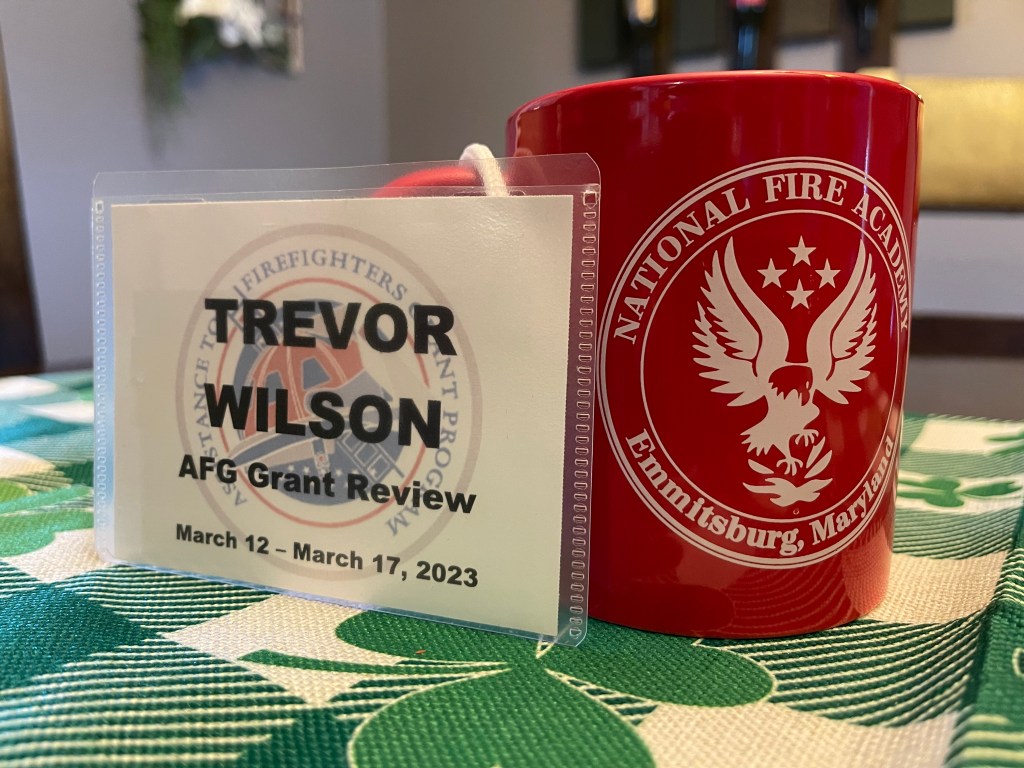
A few months ago, the International Association of Fire Chiefs (IAFC) requested volunteers to sit on the Federal Emergency Management Agency’s (FEMA) Assistance to Firefighters Grant (AFG) review panel at the National Fire Academy (NFA) in Emmitsburg, MD (there was also a remote panel option). My decision to apply was a no-brainer. I had long wanted to take a look behind the curtain of the grant process, and any excuse to get back out to the NFA (especially one that does not involve a six-month research paper) sounded good to me.
FEMA provided a one-hour online training the week before our arrival and ensured each reviewer had access to the FEMA Go website. Once on campus, volunteers from around the country and various organizational roles reviewed grant applications from 0800-1730, Monday through Thursday (I cannot speak to the remote reviewers’ experience). Our group’s volunteers came from career departments, which mirrored the organizations whose proposals we were reviewing.
We were placed into groups of 5-6 people. Each proposal was assessed via the FEMA Go website by three assessors, all from the same group. This format led to a fair amount of discussion about each reviewer’s preferences and interpretations of both the Notice of Funding Opportunity (NOFO) and the applicants’ narratives.
Here are my key takeaways:
Tell your story – The reviewers will only know what you tell them. Make your case clearly and concisely, but provide all necessary facts and background information to substantiate your request. There are differing schools of thought on the benefits of brevity (depending on the reviewer), but you will need to be thorough in your response to gain the highest marks.
Know your audience – “You can’t con a con artist.” Most of the men and women on our review panel were executive officers. Many of them have written grant proposals or pitched similar projects to their authorities having jurisdiction. They know the game and will not be fooled by fluff or circular logic. Provide the reviewer with the meat they need to get behind your vision. For this reason, it is a best practice that the grant writer has practical fire service experience. It was readily evident when a city administrator had written a proposal, as there was a greater focus on the liability and overhead for the city than on how the initiative would improve service delivery and benefit the community. Ideally, all lenses should be considered, but skipping over the operations-related aspects never faired well.
Write to the prompt – This one seems obvious, but most departments failed to write to each part of the different prompts. Here’s the closest thing to “inside baseball” I can share with you – the grading mechanism is tied exactly and singularly to the prompt. If the prompt mentions something, write to it! Then after you’ve written to it, try to think about that part of the prompt through a different lens and write about it again. Do not write about things that have nothing to do with the prompt (trying to shoehorn in demographic information in a prompt asking about critical infrastructure) or repeat the same information verbatim in different areas. The competition for these funds is exceptionally tight, so leave no points on the table. (Bonus – give a high-level itemization of your budget in the financial need narrative and explain anything that looks wonky)
Provide data – Are you asking for new extrication equipment? Speak directly about how many extrication incidents you have had in your response area in the last 1-5 years. If you have an idea of the projected service demand, share it. Provide context to your equipment budget (specific dollar amounts) and why you could only fund the purchase with the grant money. Tell me your maintenance plans and how you will pay for them. These details take a narrative from good to great, making it extremely difficult for a reviewer not to award full credit.
Be consistent – Take the time to ensure all of your numbers match, from line item to narrative and narrative to narrative. Inconsistencies kill credibility, and while they may not preclude your organization from receiving an award, they make it almost impossible to gain a top score. If there are inconsistencies, please explain why. The reviewers should not have to break out a calculator or play junior detective to determine how you arrived at seemingly disparate figures.
Consider the optics – First off, only ask for what you need. It is a typical fire service mentality to ask for the moon and settle for what you get. Do not do that here. The funding is limited, and unless your department is in dire straits, asking for more than you need is a bad look. The opposite is also true; one department received full support mainly by showing they were willing to fund 25% of the items they desperately needed. If you have a long list of requested items, address each separately. “These guys just have a Christmas list!” was overheard several times. Consider the optics of your request and address any inconsistencies.
Be intentional – This should go without saying, but take some time and thoroughly review the application before submission. There were cases where volunteer departments had mistakingly chosen “Career Department” and others where narratives were skipped. There were several instances of departments clearly cutting and pasting past narratives with outdated budget and incident information. I saw one that appeared to have been written pre-COVID. (Look, I am all for reusing a successful narrative if the same case can be made, but give me a little effort!) Know the NOFO and double-check that the items you are requesting are supported. For instance, if the NOFO says it will only replace PPE older than ten years, do not request a second set to go along with the gear you bought five years ago. Also, it is best to stick to high and medium-priority items.
Paying a grant writer – This topic is worthy of a separate post. In our group, it felt like grants written by a paid third party were judged more critically (just my impression). Some were extraordinarily well-written and landed a significant return on investment. Others were average at best. It is worth noting that choosing not to use a professional also occasionally pays dividends. We saw a handful of examples where the author was clearly out of their depth but giving a yeoman’s effort. They received the benefit of the doubt whenever feasible. My advice is to do your homework before signing any contracts.
Microgrants are underrated – Microgrants (those under $50,000) are an excellent way to upgrade your smaller equipment and tools. I left NFA with the impression that there was less competition in this area, thus increasing the chance of funding. These are potentially easy wins for your department that can increase goodwill with your municipal administrators.
Ultimately, luck will play a significant part in who gets funded. An application might have received a substantially different grade if Group 1 reviewed it instead of Group 2. There may have been a difference if it was the first proposal reviewed in the morning or the last in the afternoon. The thirtieth fill-station request may be graded differently than the first. You cannot control any of that, but you can 100% control the quality and thoroughness of your application. Following the advice in this column will put your department and community in the best position for success.
PS – Support your people! If you are in a position to send folks to the review panels, do so, even if they will never write a grant. It is an illuminating experience to gain the perspective of these other departments, particularly those in far worse economic situations than yours. At a minimum, they will be exposed to the NFA and all the brilliant minds gathering there weekly. I am very thankful for the leadership of Chief Ernest Malone for giving me so many opportunities for professional growth, and I will pay that forward whenever given a chance.


 IPSC - Fire Service Musings