
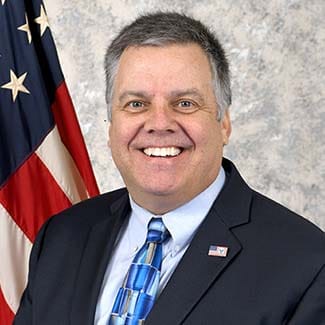
While on campus at the National Fire Academy (NFA) recently, I had the pleasure of interviewing the NFA superintendent, Eriks Gabliks. He was very gracious with his time, speaking with me for nearly an hour about his career and vision for the NFA. To hear more about the latter and his priorities concerning professional development, check out the latest iCHIEFS podcast with Tom Jenkins and Joe Powers. This post will explore Superintendent Gabliks’ journey in the fire service (from one coast to the other and back) and the learned lessons he is applying today to positively impact the American fire service.
The Gabliks family traces their American heritage through Ellis Island. Both of Eriks’ parents came to the United States from Latvia via Germany after World War II. His mother’s family was sponsored by the Lutheran church and settled in New Jersey. Her parents were blue-collar workers; her dad was a maintenance worker for a fraternity at Rutgers University , and her mom worked as a seamstress at a handbag factory. Eriks’ father was sponsored as a laborer by a farmer in West Virginia and would earn his citizenship by serving as a combat engineer in the Korean War. Returning home, he used the GI Bill to graduate from Rutgers University before becoming a technical writer for RCA.
“The impact that my parents’ experience had is one of, I would say, service and assistance,” Gabliks stated. “They received help to flee Communism, to come to the United States. As a result, they taught my brother, sister, and me that it was important to help others.”
The lessons were not lost on their children. All three would seek out careers in public service. Eriks’ brother, Maris, was the State Firewarden for the New Jersey Forest Fire Service before retiring to serve as an Eastern Region Cooperative Fire Specialist for the United States Forest Service. Their sister, Inga Gabliks, is the New Jersey State Park Service superintendent.
“All three of us were raised to help others,” said Gabliks. “I think we learned some great values, and they are something we seek to apply.”
New Jersey Experiences
One of the common themes throughout our interview was the importance of building coalitions and nurturing relationships. One of the most important relationships of Gabliks’ career was with a police officer named Toby Roe. The Gabliks grew up next door to the Monmouth County Police and Fire Academy, and the children would often play there after-hours. In this setting, Roe, a volunteer fire chief with the Adelphia Fire Company, approached Gabliks with the idea of joining the fire service.
“How come you don’t wanna join the fire company?” Roe asked the 18-year-old Gabliks. “You really should.”
“I’ve never been asked,” Gabliks replied.
“Well, I’m asking you!”
And with that, one of the more interesting and impactful fire service careers was born. It was also the first of many times that Gabliks would say “Yes” to a new opportunity, a significant factor in his success and career development.
In the 1980s, the Adelphia Fire Company was one of five volunteer departments serving the roughly 33,000 residents of Howell Township. Gabliks quickly learned that being a member meant more than just responding to calls. Every person was placed on a committee and expected to pull their weight. One of the most important was the carnival committee. Its members were responsible for producing an annual fund-raiser that traditionally generated close to $100,000 (the carnival has not been held since the mid-1990s, replaced by other fundraising measures).
Gabliks found himself as the carnival committee chair at 25. He grasped the opportunity, learning the importance of branding, fundraising tactics, and working with elected officials. He engaged other agencies to obtain the mandated permits and licensure. Internally, he collaborated with department members to gain their buy-in and ensure the event was staffed and successful.
“You learned how to communicate with people. You knew how to work with elected officials,” Gabliks stated. “You learned how to write for the brand, tell people what you do and why you do it. That was one of the big things from Adelphia that I got a lot of experience out of.”
Gabliks also gained experience on the career side of the fire service during these years by serving as a public education officer for the Howell Township Fire Bureau. Another benefit of his time in Howell Township was that it provided invaluable insight into managing department expansion. He watched his community explode to nearly 100,000 residents in under 20 years. It was a time of professional growth that planted seeds that continue to yield fruit.
Go West, young man
While at Rutgers, Gabliks met his future wife, Kelly. Originally hailing from Oregon, she persuaded her husband to follow her westward. The decision to leave his comfort zone afforded Gabliks a perspective that only some ever gain: an understanding of the differences between the eastern and western fire services.
One of the primary variances between the two coasts was the approach to emergency medical service (EMS). In the east, EMS was usually provided by a volunteer first-aid squad, a third-party provider, or the local hospitals. In Oregon, career departments were the frontline providers. A person would often need to be an emergency medical technician-basic to be eligible for hire.
The two locales also had contrasting promotion approaches. In New Jersey, officers were elected by the membership. In Oregon, firefighters wishing to promote had to meet baseline training requirements and were chosen through an interview process. Once selected, they were then expected to meet continuing education requirements.
“It was a different type of call volume, because it wasn’t as urban,” Gabliks said, “but the expectations of the members were higher from a ‘what it takes to be a volunteer firefighter with us’ standpoint.”
Gabliks’ career really hit its stride after relocating. He gained practical experience working at combination departments in Tualatin Valley and the City of Dallas (OR). More importantly, he took his first position with the Oregon Department of Police Standards and Training (today known as the Oregon Department of Public Safety Standards and Training [DPSST]).
Gabliks started as the state 9-1-1 training coordinator, working with both police and fire personnel. He concentrated on improving curriculum development, program implementation, and coalition building. These became strengths that, with his past experience, made Gabliks an obvious choice when the position of fire program supervisor became vacant.
“Not only working in the volunteer setting, but also working in a 9-1-1 call center for a while, you understand how to multitask,” Gabliks said. “You understand how to listen to people, how to work with people.”
Around this time, the responsibility for fire training had shifted from Oregon’s state fire marshal’s office to DPSST. Before the move, the state training program was struggling to make an impact. In addition to his role as the fire program manager, Gabliks was chosen to serve as the state fire training manager.
“When I became the fire training manager, there was a lot of discontent, partly because a connection with the stakeholders had been lost,” Gabliks explained. “The program had not been listening to what the fire service wanted.”
Gabliks and his staff quickly went to work gathering program requests and pouring over incident data. They then created and communicated a strategic plan based on their findings and the available budget. The training delivery was left to the departments, with DPSST acting in a supporting role. The changes were met with enthusiasm and helped the new program add staffing and budget in subsequent years.
When the opportunity to promote to the training division director arose, Gabliks was again prepared. In this new role, he oversaw training for not only police and fire but also 9-1-1 telecommunicators, parole officers, corrections, and private investigators, among others. He continued to learn and broaden his collaborative networks, gaining further insight into the needs and cultures of the different programs under the DPSST umbrella. These efforts would continue to pay off as he became the deputy director and, eventually, the DPSST director.
The DPSST director position provided outstanding training for Gabliks’ future role at the NFA. He was responsible for a massive training program providing residential and off-campus courses. He oversaw the development and enforcement of professional standards and the awarding of certifications across several programs. He also learned the importance of working with state and federal elected officials to ensure his programs were funded and their needs were met.
The biggest lesson learned was the power of collaboration.
“Police and fire testified together on our agency’s budget, supporting what we do,” Gabliks explained. “Even though the police received more resources because their training and certification were mandatory, they also saw the value and benefit of fire training and certification. So they spoke together, and that built that partnership.”
Gabliks also learned how to juggle the needs and desires of disparate programs.
“We were serving very diverse groups who often don’t get along. Police and fire are always competing for that same resource. It was important to listen to them and provide them what I could within my budget and staffing,” Gabliks said. “I saw my role as more of a city manager, managing those relationships.”
This situation was similar to the one he faces today.
“What we run into here (at the NFA) is that we have seven areas of concentration: leadership, hazmat, EMS, fire investigation, fire prevention, woodland urban interface, and fire training. All of those are important and need the same care and feeding as the others. So it’s kind of like being a parent. Every kid needs new shoes, but you can’t afford to buy new shoes for every kid every year. So you figure out where you put the resources to keep everybody moving forward.”
Taking the leap
As Gabliks closed in on ten years in his role as the DPSST director, he received a call from a recruiter suggesting he put in for the superintendent’s position at the NFA. His resume checked off most of their wish list items. He had extensive experience in training and working with various organization types and sizes. He was familiar with managing residential and off-campus training programs, and he understood the different nuances of the fire service across the country.
Gabliks was also very familiar with the NFA. Having first attended a New Jersey weekend program while at Adelphia, he continued to visit the campus after moving to Oregon. He also successfully completed the Executive Fire Officer Program. Finally, he applied and was chosen to serve on the NFA’s Board of Visitors (BOV) for three years.
Gabliks credits his stint on the BOV as significant to his career. He had become aware of the group through his membership with the North American Fire Training Directors and the Congressional Fire Service Institute. Appointed by the president, board members look at the NFA’s programs, facilities, and budget and make recommendations to the United States Fire Administration (USFA) administrator and the Federal Emergency Management Agency administrator to ensure the stakeholders’ needs are being met. Gabliks’ time on the board provided vital insights into the state of the NFA and its funding mechanisms.
When the recruiter’s call came, Mrs. Gabliks supported the move.
“You love the NFA,” Kelly said. “What a great opportunity for you to work and help lead at an agency that you’ve gotten so much out of! You moved across country for me; I’ll move across country for you.”
“And the rest is history!” said Gabliks.
What’s next?
Two familiar themes reemerged when asked for his primary focal points for the NFA. Gabliks believes there is a branding issue that must be addressed. He is also focused on ensuring the stakeholders’ needs are being met.
“The first one is probably the most important one (and I would say an issue for the USFA as a whole); there are a lot of people that don’t know what we do. There are a lot of people that don’t know there is an NFA or USFA,” Gabliks said. “My first goal (and it’s a constant goal with us) is messaging, branding, and telling people that we are ‘YOUR NFA.’ It doesn’t cost you anything to come here (aside from meals), and we provide amazing professional development opportunities.”
He is upfront that there are other training opportunities available, and many of them are excellent. However, he also advocates that the NFA campus provides unique networking opportunities and a safe space to have honest conversations that may not be possible a little closer to home.
The other focal point is ensuring the stakeholders’ needs are met. Feedback is gathered from each course to ensure the course materials and delivery meet the students’ needs. Course curriculums and content must also be constantly reviewed.
“The second one (focal point) is making sure that our courses are staying fresh and relevant. We deliver nine two-day classes in every state and three six-day classes in every region that we take to a location that they pick. I call that the front window of the store. Those two-day classes, especially for volunteers, are the only thing that they know about the NFA. So we have to have that display case full of new things for them to experience so that hopefully those two-day classes will get them to take a six-day class.”
Key takeaways
Here are some of my key takeaways from this discussion:
- Never underestimate the potential of a sentence, an invitation. Think back to Toby Roe off-handedly asking an 18-year-old to join his fire company and the downstream effects.
- Gabliks continuously sought growth opportunities. As a result, he gained knowledge and perspectives that few could rival. He also built a valuable network solidified by his high-quality work. This pattern started with taking leadership roles on committees in Adelphia and continued throughout his career at the DPSST and his involvement with several professional organizations.
- Branding matters. To quote Simon Sinek, “Start with why.” Concentrate on inspirationally sharing your vision. At heart, everything we do should revolve around public service.
- Meet your stakeholders’ needs. Begin with learning what they want and follow up with data. The worst thing one can do is make decisions in a vacuum. Also, one should not rely on data alone as it can easily miss the human element. The stakeholders will usually best know what they need.
- Build collaborations and nurture relationships. Identify new opportunities and then solidify your alliances. Put the time in to build connections that are deeper than transactional.
- Learn who controls the purse strings. Work with your labor organizations and neighboring departments to lobby at the municipal, state, and federal levels, but also market your department to your community members.
- Hustle. The superintendent is seemingly everywhere, all of the time. I have run into him in airports and at conferences. Whenever I open LinkedIn, I am greeted by his messages sharing what’s going on at the NFA or the great work the USFA is performing. He visits classrooms on campus and has lunch in the cafeteria every day. Heck, one day last year, he met me on the way to class with a giant easter egg full of Dunkin’ gift cards. He is always selling the brand and getting the word out. His energy is infectious.
I want to thank Superintendent Gabliks for his time and the opportunity to learn more about his story. I would also like to speak for many of us and thank you and your team for everything the NFA provides.

 IPSC - Fire Service Musings