
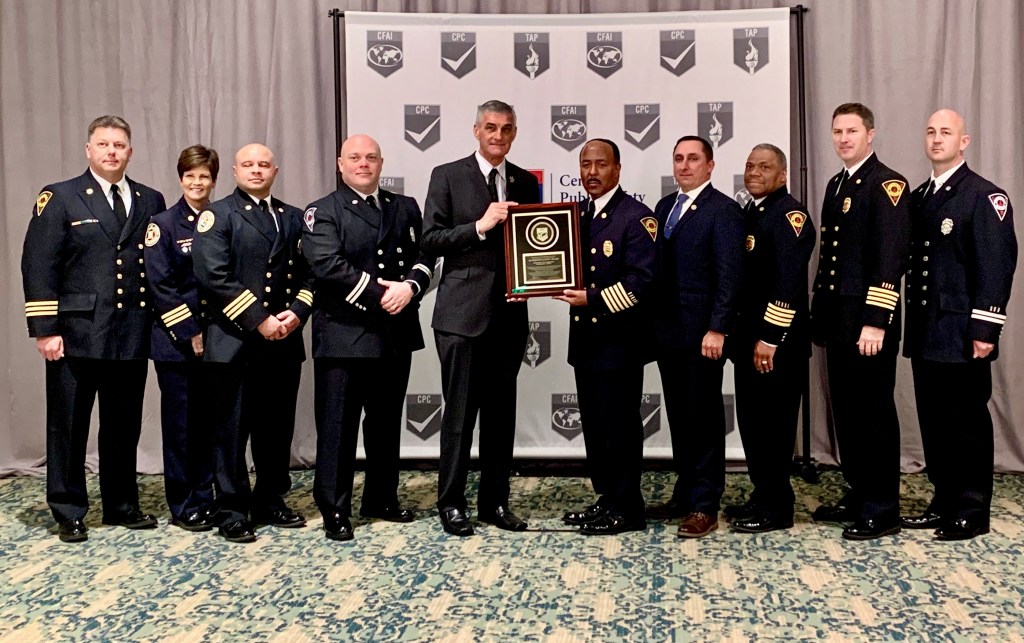
The Indianapolis Fire Department’s efforts to gain international accreditation through the Center for Public Safety Excellence’s (CPSE) Commission on Fire Accreditation International (CFAI) began in 2015. The department’s first accreditation manager (AM) (a deputy chief with extensive experience) attended the Quality Improvement through Accreditation course (now called the Quality Improvement for Fire and Emergency Services) in March. As the CFAI was about to transition from the 8th edition of the Fire and Emergency Services Self-Assessment Manual (FESSAM) to the 9th, the decision was made to wait until the following year to begin work on the process. During that time, the planning office was established, and the positions of planning chief and performance and compliance officer (my position) were created.
All three team members went through the QITA class in early 2016. The early plans were to divide the work evenly. The AM took on the community risk assessment (CRA) and standards of cover (SOC); the planning chief naturally assumed responsibility for the strategic plan (strat plan); I became responsible for the self-assessment manual (SAM). As anyone who has been through the process understands, this approach was a disaster. The AM was too busy with the day-to-day responsibilities of being a deputy chief of a metro department to make significant headway on the CRA. The planning chief was left waiting for the CRA’s environmental scan to be completed before moving forward with the strat plan. With the help of the planning chief, I took off like a bull in a china shop working on the SAM but quickly realized that I would only be able to complete half of it without either a strat plan or SOC. Communication was lacking, balls were dropped, and resentment grew.
I do not share this to point fingers. Everything that happened eventually strengthened our department and helped inform our current practices. “We didn’t know what we didn’t know” when starting the process. I offer this tale to speak to the importance of intentionally developing a well-thought-through plan before beginning the accreditation (or even CRA) process. Here is a list of essential topics to discuss at the outset:
- How large of a team will you need to complete this process?
- Can you afford to have people singularly dedicated to this task?
- If not, what is a reasonable expectation for each team member’s contribution?
- What are the broad, narrow, and specific steps that will need to occur for each phase?
- How long will each step take and who will be responsible for its completion?
- What is your target date for completion? Work a timeline and Gannt chart backwards from then.
While these are obvious program management questions, only a few were initially contemplated. The AM believed we could finish the process in less than nine months. I often hear similar sentiments from newly registered agencies until they realize this is not just another project that can be finished by “borrowing” and cobbling ideas from other departments. I believe a skilled and dedicated team at a mid-sized department (60-100 firefighters) can produce quality work across all three process components in 18-24 months. However, this will likely not be enough time for institutionalization and culture change, and it is more realistic to aim for three to four years in most cases.
Back to IFD, we found ourselves unable to move forward at the end of our three-year registration period (2015-17). We decided to hit the reset button and completely retool our approach. I moved into the role of AM. We promoted a new performance and compliance officer, and a graphic designer was detailed to the office. All hands were concentrated on the CRA and SOC for the following year. Most of the initial SOC work was salvaged, leaving enough to write the sections covering our community and the organization of our department. As 2018 ended, we felt confident enough to move to applicant status. A plan was developed to ensure all core competencies were met, and a new bi-weekly executive staff meeting rotation ensured that our efforts stayed on track. We completed our strategic plan and SAM in nine months, moving to candidate agency status in alignment with our original timeline. This expedited sprint was only possible due to the pre-work that had been done on the SAM in 2016-17.
Through my time as a peer assessor and consortium facilitator, I have learned that our story is not unique. Denver’s path to accreditation was similar in many ways (in fact, their sprint to the finish inspired us to give it a go). Grand Rapids invested ten years before sitting in front of the commission. They are now a model department proving how striving for data-driven continuous improvement can revolutionize a community’s public service. Even if it is slow going at the beginning, stay the course.
Some key takeaways:
- Your department’s success will match the level of support shown by the fire chief.
- The most qualified and experienced person is only the right fit for the AM position if they have the time and passion required to drive such a large initiative.
- I feel strongly that the strategic planning process needs to start with the community risk assessment. There is a conversation to be had about whether the standard of cover should be determined before, after, or concurrent with the strategic plan.
- Do not just look for trends or pull pieces from other departments’ strategic plans. You will get destroyed by your peer team, but more importantly, it flies in the very face of why you should be pursuing accreditation.
- Do lean on your peers, especially those who have recently become accredited for the first time. Join your local consortium. Build networks with like-minded individuals who support each other, trade ideas, and share resources.
- To the AMs: You will not win every battle. Know where to spend your capital. Control the controllable, and work to influence everything else.

 IPSC - Fire Service Musings